
"African women Researchers": my series dedicated to African scientists
Parasitologist, physicist, entomologist... every month, I share the journey of one of these women who, despite the difficulties, use science to solve the continent’s problems.

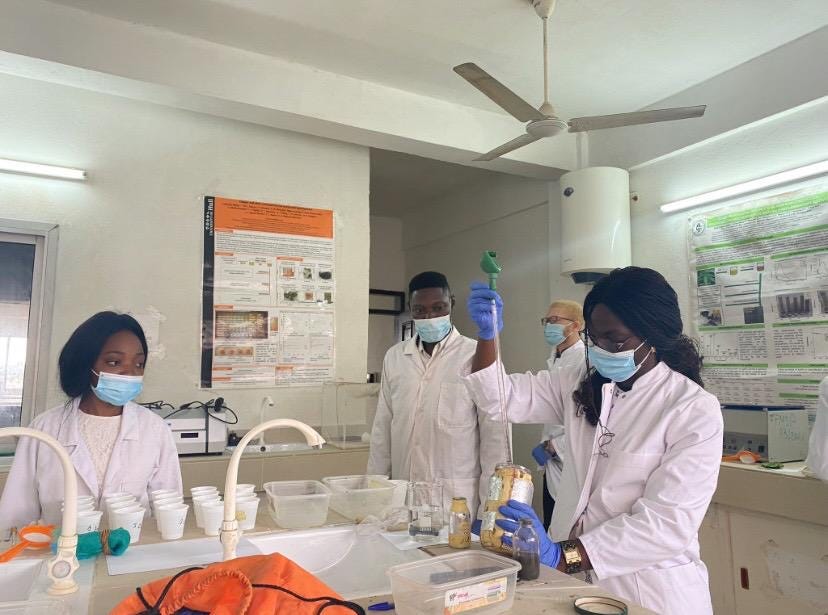
When Patricia Doumbe Belisse obtains her baccalaureate, her joy was short-lived. Very quickly, her parents explained her how they see the rest of her educational life. Professional training that will then allow her to become financially independent and take care of the family. There was therefore no question of pursuing long medical studies, a dream that the young bachelor’s degree nurtured.
Despite the pressures, Patricia was stubborn and didn’t let go. After two failures in the entrance exam to medical school, she enrolled at the Faculty of Science of the University of Yaoundé I, in the capital of Cameroon.
During her master’s cycle, Patricia Doumbe Belisse discovered a field that perfectly combined her passion for public health and science: parasitology. She chose to focus on mosquito-borne diseases, which allowed her to be in direct contact with communities during her research work.
34% of researchers are women
On the family level, however, Patricia Doumbe Belisse was isolated. Her parents did not understand why she left home early, came back late and did not regularly participate in housework. “Conducting research was a challenge because I did not receive any support from them,” recalls the one who will eventually obtain her doctorate in parasitology and ecology.
Dr. Patricia Doumbe has since joined the department of vector biology at the Liverpool School of Tropical Medicine where she works on the project to combat the emergence of Anopheles stephensi in Sudan and Ethiopia (Controlling the Emerging Anopheles stephensi in Sudan and Ethiopia) as an associate researcher.
The history of this medical entomologist is the norm rather than the exception in many African countries where the path to research is dotted with countless difficulties for women. According to the African Development Bank, 34% of researchers are women in Africa. A figure that actually hides “great disparities” across the continent. In Cape Verde, for example, 52% of researchers are women, 47% are in Tunisia, and 40% in South Africa and Uganda. “Guinea is at the other end with only 6% of women among the researchers,” notes the Bad.
In some regions such as Central Africa, the situation is alarming: 3.4% in Chad; 9.8% in Equatorial Guinea; 8.7% in the Democratic Republic of Congo compared to 12.8% in neighboring Congo. For Professor Francine Ntoumi, stereotypes block the evolution of women in science.
Despite the statistics that show that young girls most often get the best results during their primary and secondary studies, “the more we go towards the doctorate, the fewer women are present,” the parasitologist told me.
Because stereotypes are firmly anchored in African societies: the woman at a certain age must marry, have a family life, take care of her home as a priority and not her professional career. “Then the woman must not be ambitious,” said Professor Francine Ntoumi with regret. “For a woman it is negative. A woman who studies for a long time is a woman who has failed in her personal life.” Faced with these blockages, those who commit and succeed overcome many obstacles.
You can read the full introduction of my series on Agripreneurs d’Afrique.
Have a good read and see you next week!